At a glance
Project summary
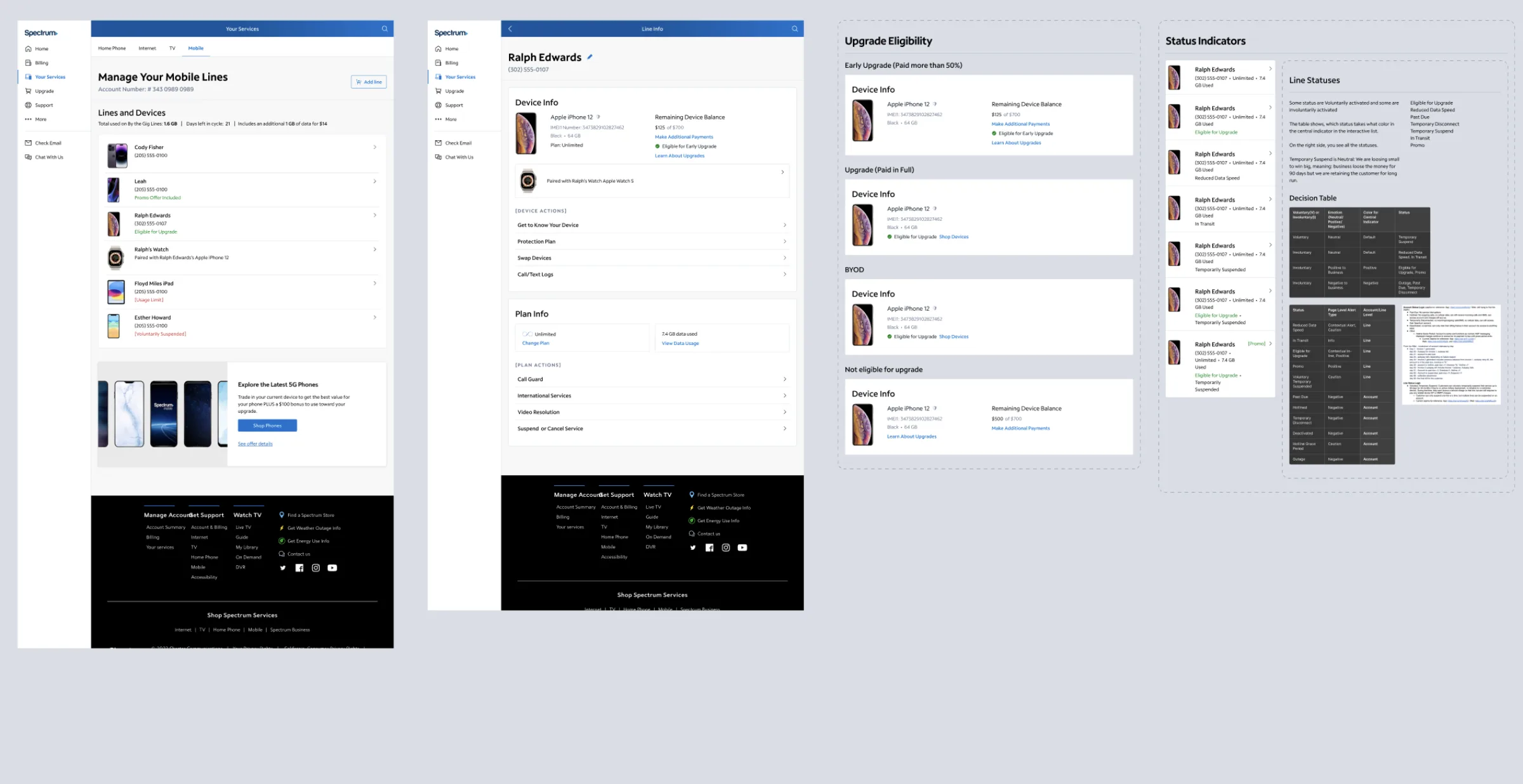
International roaming information and controls existed across different parts of the Spectrum experience. The opportunity was to make international services easier to discover, understand, and manage from the customer’s existing line-management experience.
The design brought together roaming control, rate discovery, usage visibility, and future international services into a more cohesive experience.
The problem
International roaming was more than a settings problem
When customers travel internationally, they need to answer three basic questions:
- Can I use my phone internationally?
- What will it cost me?
- Can I control whether roaming is enabled?
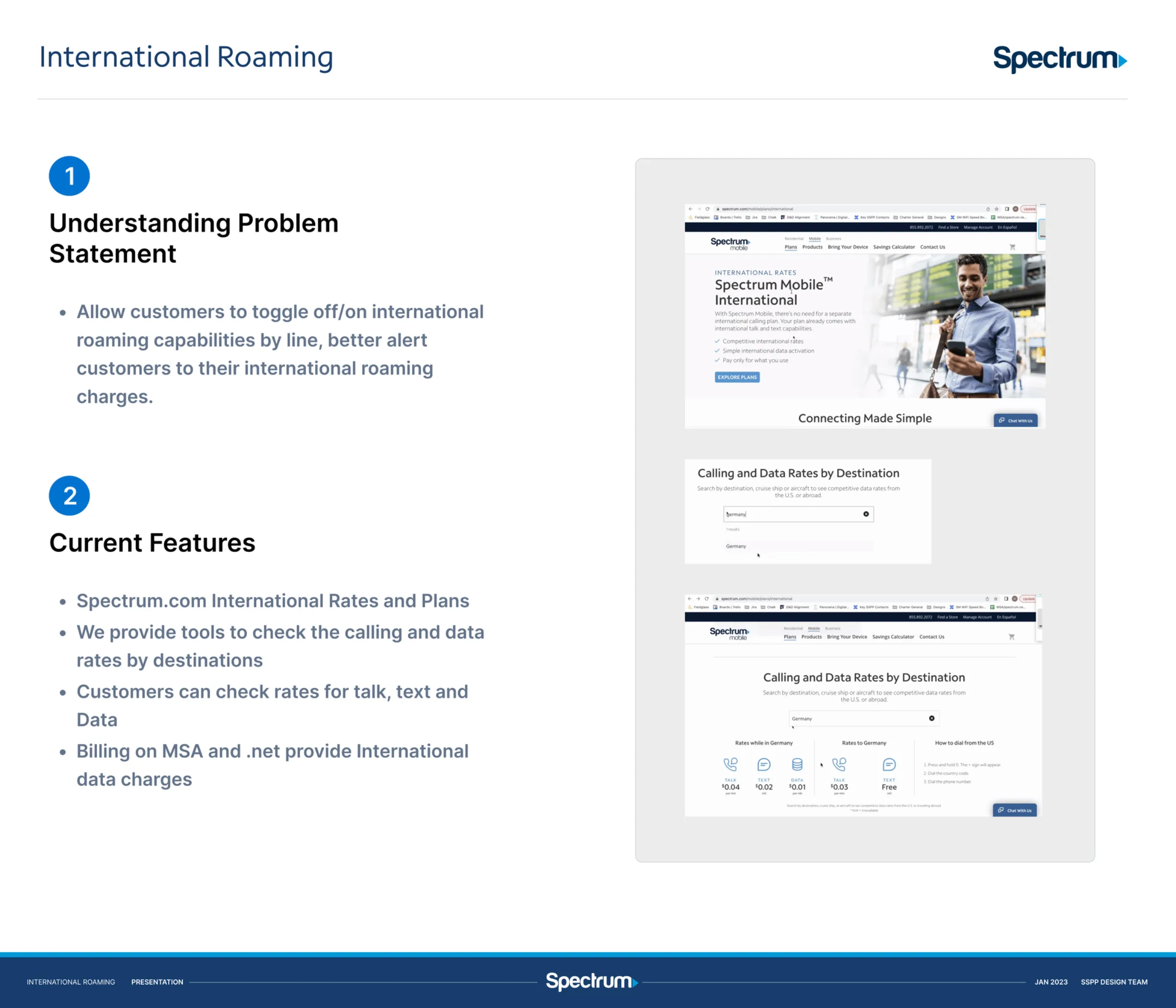
Spectrum already provided international rate information, but the information and line-level controls were not fully connected within the customer’s account-management experience.
Design challenge
How might weGive customers enough context to make an informed roaming decision while keeping control simple and accessible at the line level?
The opportunity
From information to control
The project evolved the experience from simply helping customers look up international rates toward helping them understand and manage international services.
The experience connects four jobs
Discover
Find international services and rates.
Understand
See voice, text, and data pricing by destination.
Control
Turn data roaming on or off for a specific line.
Monitor
Understand roaming usage and charges.
Design principle
PrincipleHide the complexity, not the control.
The underlying roaming system contains multiple tiers and market-specific rules. Customers should not need to understand that internal complexity to make a simple decision about their line.
The system
A simple UI sitting on top of a complex product model
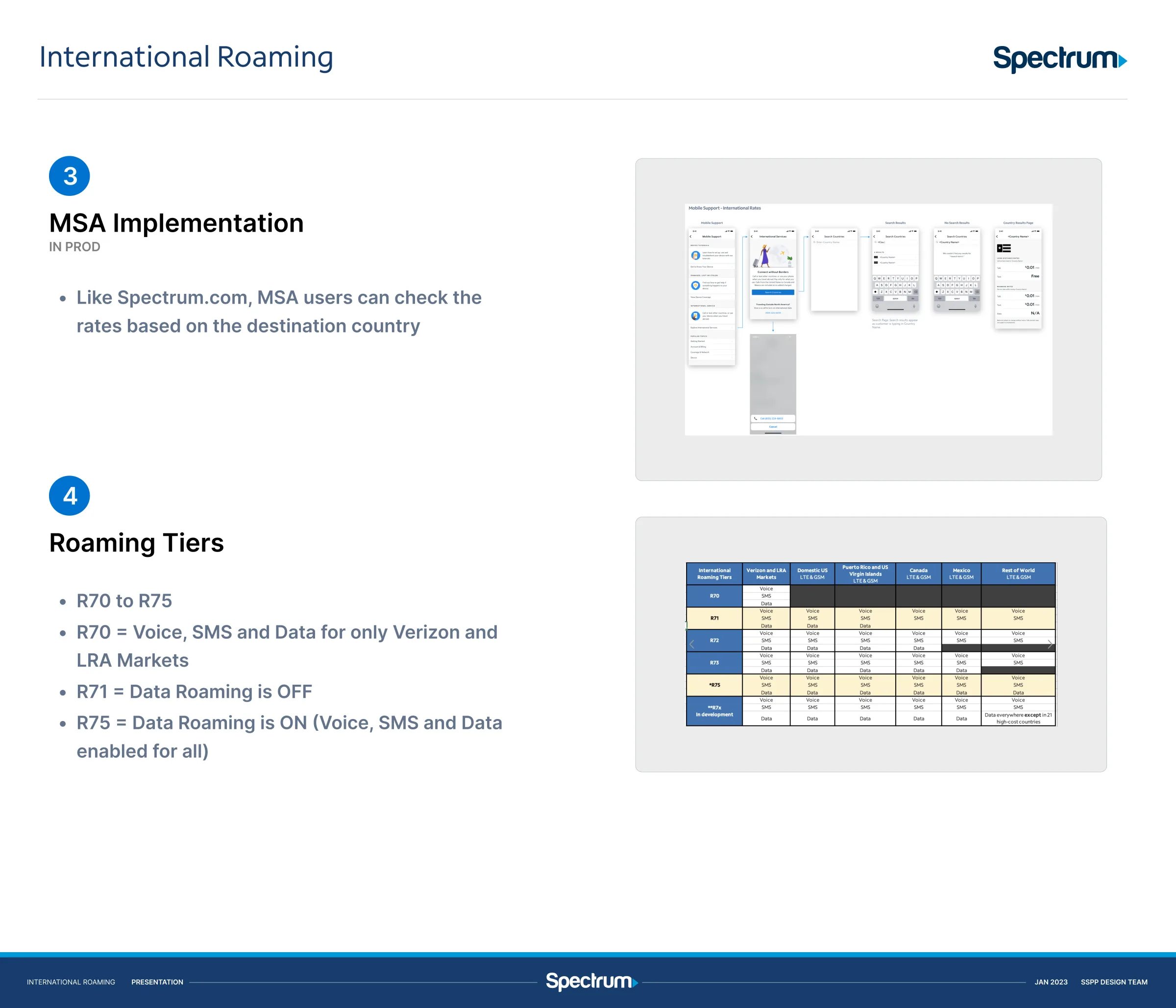
The roaming experience is governed by multiple roaming tiers, with different combinations of voice, SMS, and data availability. For example:
- R70 — Voice, SMS, and data for Verizon and LRA markets.
- R71 — Data roaming is off.
- R75 — Data roaming is on, with voice, SMS, and data enabled more broadly.
- R72 / R73 — Additional market/service combinations.
The important UX challenge was not to expose this tiering directly to customers. Instead, the interface translates complex product rules into a simpler customer-facing model:
Roaming is ON/OFF → Here is what you can do → Here is where to understand rates and usage.
How I think about itOne of the interesting challenges was that the UI looked simple, but the underlying business logic was not. I had to think about how much of that complexity belonged in the customer experience versus the system layer.
Information architecture
Introducing “International Services”
Rather than treating roaming as another isolated setting, the design establishes International Services as a dedicated destination within line management.
Why this matters
The information architecture supports both today’s requirement and future international capabilities.
- Data Roaming
- International Rates
- Roaming Usage
- Data Roaming
- International Rates
- Roaming Usage
- International Day Pass
- Additional international services
This makes the feature more scalable than adding separate international functions throughout the account experience.
How I think about itI didn’t want to design only for the immediate requirement. The name and structure of the destination were intentionally broad enough to support additional international features later.
Data roaming
Turning a complex decision into a simple control
At the customer level, the decision is binary:
Should this line be allowed to use mobile data while roaming internationally?
A toggle communicates both the current state and the available action in one place.
Why a toggle?
A toggle was preferable to a generic action button because it makes the current state immediately visible.
With a toggle, the user can immediately understand:
- Current state
- Available action
- Whether the feature is enabled
This is particularly important for a service that can have billing implications.
Trade-offs
Simplicity vs. informed consent
A roaming toggle is easy to understand, but the action has potential financial consequences. That creates a tension:
| Design goal | Potential downside |
|---|---|
| Keep the control simple | Users may not understand potential charges |
| Show more pricing context | The interaction becomes heavier |
| Add a confirmation step | Adds friction |
| Make changes immediate | Increases risk of accidental changes |
| Put all information in the flow | Can overwhelm the user |
Design approach
The experience separates the immediate control from the deeper rate information. The customer can make a straightforward change while still having access to international rate information and usage context.
PrincipleProvide enough context for a responsible decision without turning a simple setting into a billing workflow.
How I think about itThe trade-off wasn’t simply whether to use a toggle. The real question was how much context should surround that toggle. Because roaming can create unexpected charges, I wanted the user to have access to relevant information without making the primary interaction unnecessarily complicated.
The flow
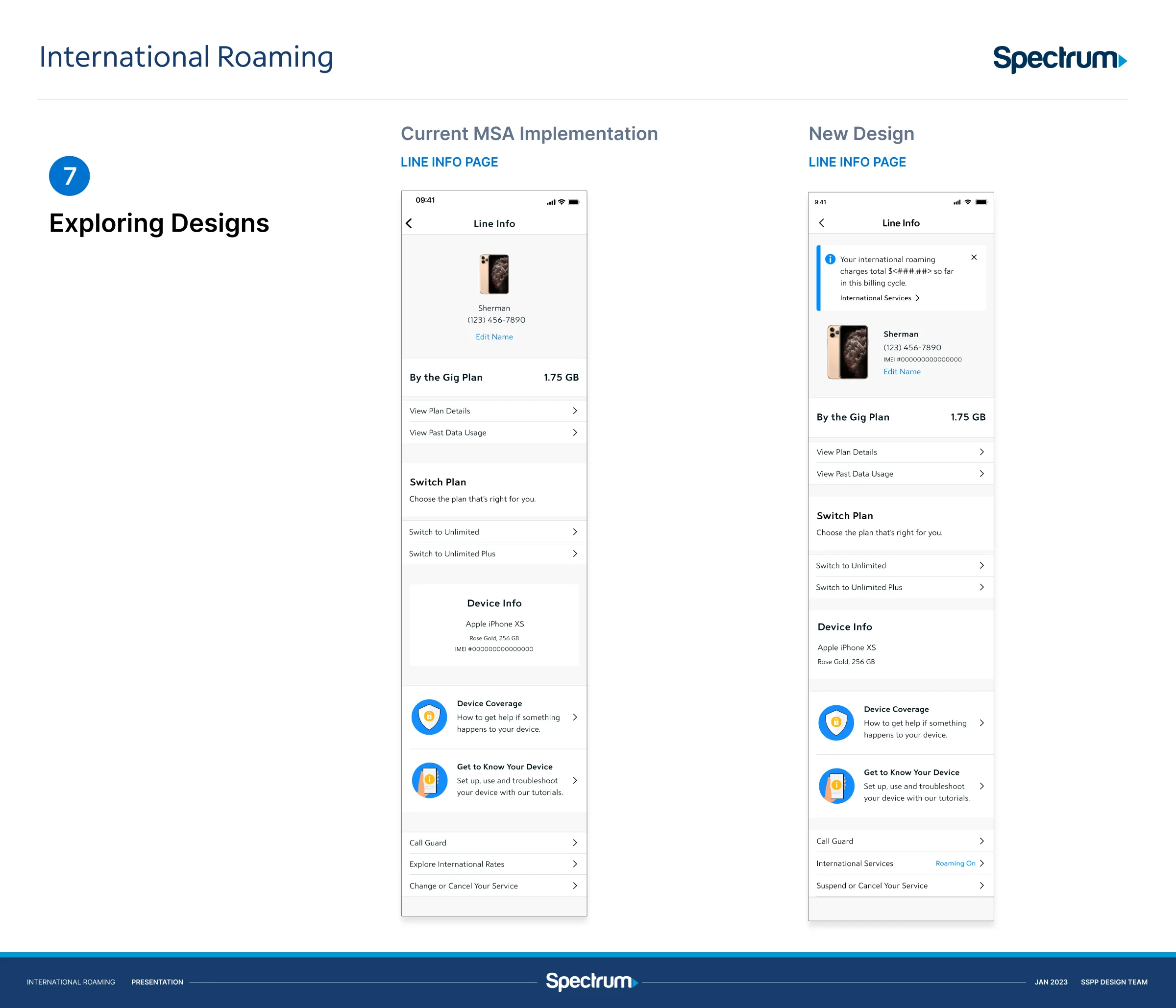
From Line Info → International Services
The experience creates a direct relationship between the customer’s line and international controls.
Failure states
The “Unable to Save Changes” state matters
A strong product experience is not only the happy path.
If a customer is traveling and attempts to disable data roaming, but the system cannot save the change, the consequence is potentially meaningful. The user needs to understand:
- The change did not succeed.
- Their intended state may not have been applied.
- They have a clear path to recover.
We couldn’t update Data Roaming for this line. Your change was not applied — your previous settings are still active.
Try againPrincipleFor financially sensitive settings, system-state communication is part of the core experience.
How I think about itI paid particular attention to the failure state because this isn’t like changing a visual preference. If the user thinks roaming is off when the system hasn’t actually saved the change, their expectations and their bill can diverge.
Rate discovery
Bringing existing information into the account experience
Spectrum already had an international rates experience where customers could search for a destination and understand:
- Voice rates
- SMS rates
- Data rates
- Rates while abroad
- Rates when calling back to the US
The design opportunity was not necessarily to recreate the pricing system. It was to make that information easier to reach from the customer’s existing account context.
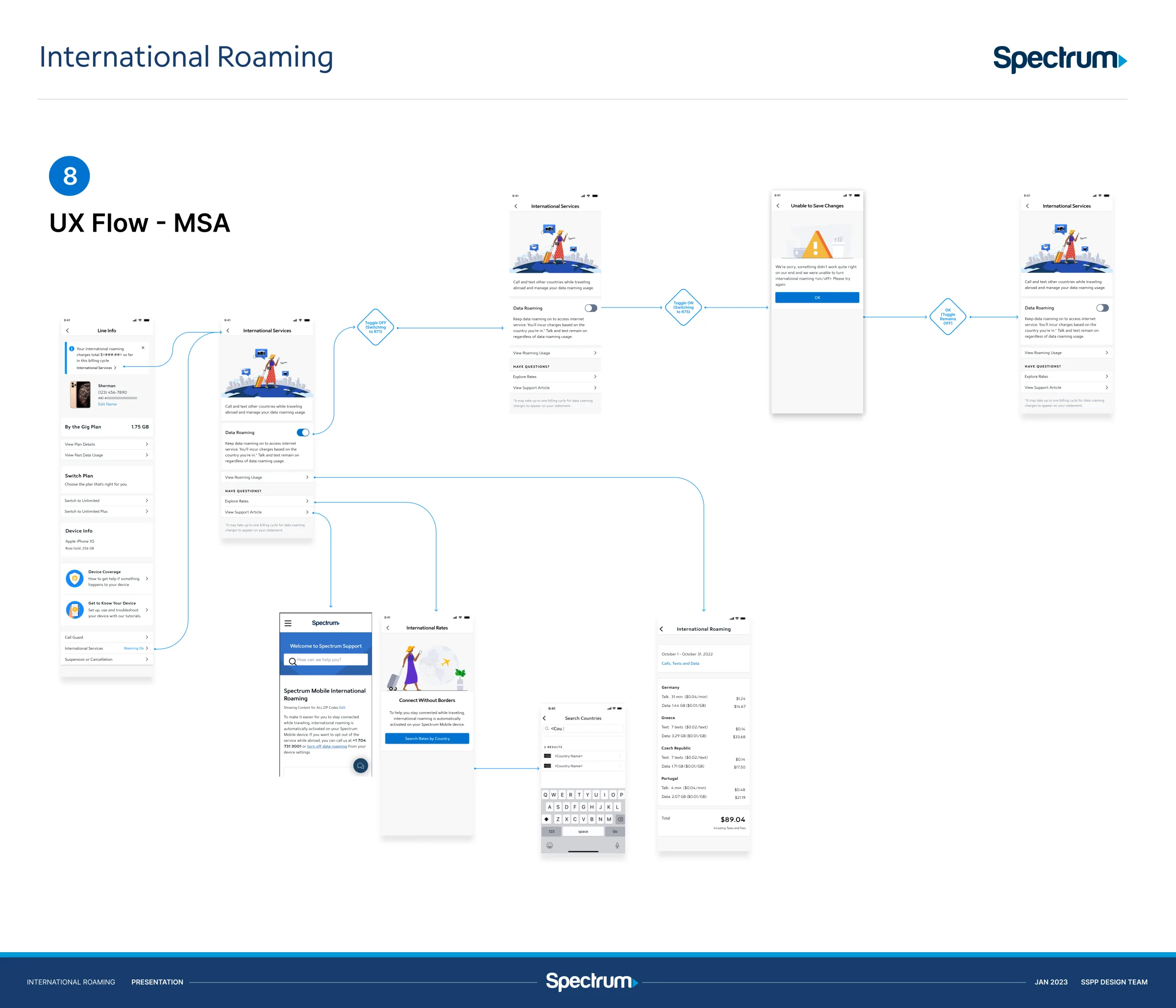
How I think about itA key product decision was knowing what not to redesign. The rate engine and information already existed, so the opportunity was to connect it to the customer’s account journey rather than unnecessarily recreate the underlying experience.
Usage & cost
Moving from configuration to ongoing awareness
International roaming is not only something customers configure before a trip. Once roaming is active, customers may want to understand what they have already used and what they are being charged.
The design therefore connects configuration with ongoing awareness:
Proactive visibility
Surfacing cost before it becomes a surprise
The new Line Info experience introduces an international roaming charge notification:
This shifts the experience from purely reactive settings management toward proactive awareness.
The trade-off
More visibility can also create:
- Anxiety
- Visual competition with primary line information
- Notification fatigue
- Reduced attention if alerts appear too frequently
PrincipleMake potentially costly behavior visible without making the entire account experience feel like a warning screen.
Cross-platform
Consistency without forcing identical UI
The experience needed to work across MSA / mobile, .NET / web, and Spectrum.com.
The goal was not to make every screen visually identical. Instead, the customer should recognize the same conceptual model:
Line → International Services → Roaming → Rates / Usage
…while each platform continues to respect its existing navigation and interaction patterns.
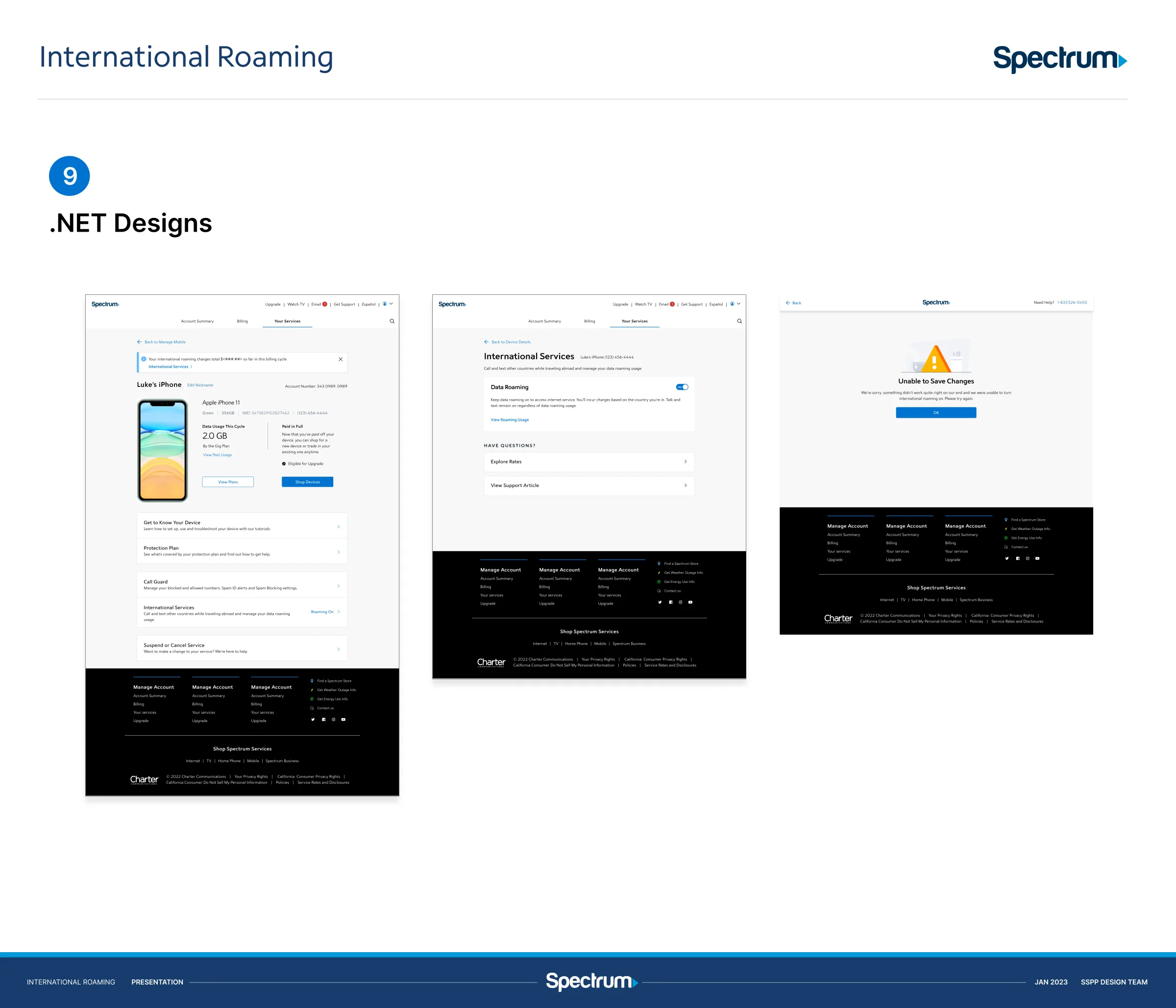
How I think about itFor me, cross-platform consistency meant consistency in the mental model and terminology, not simply copying the same UI everywhere.
Web implementation
The .NET experience extends the same model to desktop/web.
The customer can reach International Services from their line and manage data roaming without leaving the account-management context.
The broader system
International Services as a product pattern
The project establishes a foundation that can grow beyond roaming.
Current experience
- Data Roaming
- International Rates
- Roaming Usage
- Voice / SMS / Data information
Potential future experience
- International Day Pass
- Additional travel services
- More proactive usage guidance
- Additional international account controls
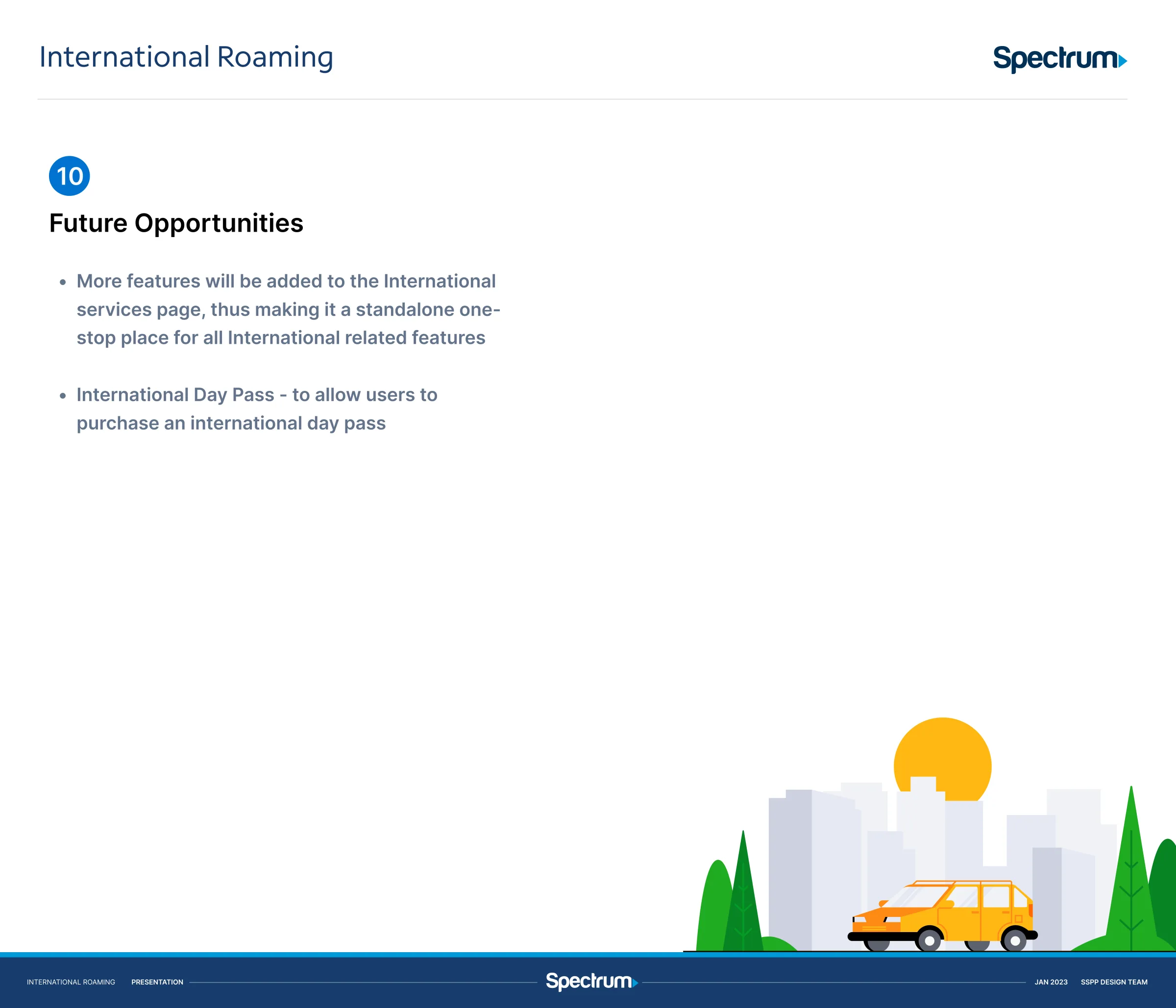
Future opportunity
Designing beyond the immediate requirement
One of the clearest future opportunities identified in the project was an International Day Pass.
The broader goal was to evolve International Services into a one-stop destination for international-related capabilities.
The immediate feature solves roaming management. The larger product opportunity is creating a coherent international-services ecosystem.
What changed
OutcomeThe design established a consistent international-services pattern across MSA and .NET, bringing roaming controls and rate information closer to the customer’s line-management experience.
Reflection
What I learned
Simple interfaces can represent complex systems
The roaming control looks like a binary decision, but the underlying product rules are much more nuanced. Good UX abstracts that complexity without hiding important consequences.
Financially sensitive actions need context
A simple control is not always enough. Customers need access to the information required to understand the consequences of their decision.
Failure states deserve first-class design attention
When a setting can affect billing or service availability, an error state is part of the primary experience — not a secondary engineering concern.
Information architecture should anticipate product growth
Introducing International Services as a broader destination creates room for additional capabilities without continually fragmenting the account experience.